Tuesday, October 7, 2025
To Ramona - Bob Dylan
To Ramona
WRITTEN BY: BOB DYLAN
Ramona
Come closer
Shut softly your watery eyes
The pangs of your sadness
Shall pass as your senses will rise
The flowers of the city
Though breathlike
Get deathlike at times
And there’s no use in tryin’
T’ deal with the dyin’
Though I cannot explain that in lines
Your cracked country lips
I still wish to kiss
As to be under the strength of your skin
Your magnetic movements
Still capture the minutes I’m in
But it grieves my heart, love
To see you tryin’ to be a part of
A world that just don’t exist
It’s all just a dream, babe
A vacuum, a scheme, babe
That sucks you into feelin’ like this
I can see that your head
Has been twisted and fed
By worthless foam from the mouth
I can tell you are torn
Between stayin’ and returnin’
On back to the South
You’ve been fooled into thinking
That the finishin’ end is at hand
Yet there’s no one to beat you
No one t’ defeat you
’Cept the thoughts of yourself feeling bad
I’ve heard you say many times
That you’re better ’n no one
And no one is better ’n you
If you really believe that
You know you got
Nothing to win and nothing to lose
From fixtures and forces and friends
Your sorrow does stem
That hype you and type you
Making you feel
That you must be exactly like them
I’d forever talk to you
But soon my words
They would turn into a meaningless ring
For deep in my heart
I know there is no help I can bring
Everything passes
Everything changes
Just do what you think you should do
And someday maybe
Who knows, baby
I’ll come and be cryin’ to you
Copyright © 1964 by Warner Bros. Inc.; renewed 1992 by Special Rider Music

Wednesday, August 20, 2025
Ulysses Alfred Lord Tennyson
It little profits that an idle king,
By this still hearth, among these barren crags,
Match'd with an aged wife, I mete and dole
Unequal laws unto a savage race,
That hoard, and sleep, and feed, and know not me.
I cannot rest from travel: I will drink
Life to the lees: All times I have enjoy'd
Greatly, have suffer'd greatly, both with those
That loved me, and alone, on shore, and when
Thro' scudding drifts the rainy Hyades
Vext the dim sea: I am become a name;
For always roaming with a hungry heart
Much have I seen and known; cities of men
And manners, climates, councils, governments,
Myself not least, but honour'd of them all;
And drunk delight of battle with my peers,
Far on the ringing plains of windy Troy.
I am a part of all that I have met;
Yet all experience is an arch wherethro'
Gleams that untravell'd world whose margin fades
For ever and forever when I move.
How dull it is to pause, to make an end,
To rust unburnish'd, not to shine in use!
As tho' to breathe were life! Life piled on life
Were all too little, and of one to me
Little remains: but every hour is saved
From that eternal silence, something more,
A bringer of new things; and vile it were
For some three suns to store and hoard myself,
And this gray spirit yearning in desire
To follow knowledge like a sinking star,
Beyond the utmost bound of human thought.
This is my son, mine own Telemachus,
To whom I leave the sceptre and the isle,—
Well-loved of me, discerning to fulfil
This labour, by slow prudence to make mild
A rugged people, and thro' soft degrees
Subdue them to the useful and the good.
Most blameless is he, centred in the sphere
Of common duties, decent not to fail
In offices of tenderness, and pay
Meet adoration to my household gods,
When I am gone. He works his work, I mine.
There lies the port; the vessel puffs her sail:
There gloom the dark, broad seas. My mariners,
Souls that have toil'd, and wrought, and thought with me—
That ever with a frolic welcome took
The thunder and the sunshine, and opposed
Free hearts, free foreheads—you and I are old;
Old age hath yet his honour and his toil;
Death closes all: but something ere the end,
Some work of noble note, may yet be done,
Not unbecoming men that strove with Gods.
The lights begin to twinkle from the rocks:
The long day wanes: the slow moon climbs: the deep
Moans round with many voices. Come, my friends,
'T is not too late to seek a newer world.
Push off, and sitting well in order smite
The sounding furrows; for my purpose holds
To sail beyond the sunset, and the baths
Of all the western stars, until I die.
It may be that the gulfs will wash us down:
It may be we shall touch the Happy Isles,
And see the great Achilles, whom we knew.
Tho' much is taken, much abides; and tho'
We are not now that strength which in old days
Moved earth and heaven, that which we are, we are;
One equal temper of heroic hearts,
Made weak by time and fate, but strong in will
To strive, to seek, to find, and not to yield.
Thursday, August 14, 2025
In Praise of KJ
1) a sonnet in praise of KJ
A screen's allure, a figure held in grace,
She steps into a world of scripted light.
With poise and passion shining on her face,
She claims the scene and holds it with her might.
Her presence fills the lens, a burning art,
A confident and captivating soul,
She gives a scene a pulse, a beating heart,
And makes the chaos feel entirely whole.
A master of the moment, pure and true,
She finds the truth within the staged design,
And in her work, reveals a vision new,
A captivating form, a bold, clear line.
Her talent shines, a star in its own space,
And brings a fierce and elemental grace.
2) After the Style of Milton
Lo, Muse, that with a solemn strain dost sing
Of Adam's Fall, and man's first disobedience,
In humble strain, attend my voice, and praise
A different grace, by modern light revealed.
For in this age, that lesser glories knows,
A name resounds, not on the fields of war
Nor from the halls where kings their scepters hold,
But from the glimmer of a glassen screen,
Where Kenna James, with visage passing fair,
And form by Nature’s cunning hand well-wrought,
Doth move. Not as a shepherdess, whose pleas
Could sway a god to grant a fruitful spring,
Nor as a Queen, with sceptre and with throne;
But as a player, who doth lend her soul
To fictions born of light, and fleeting shade.
Her motion, like a goddess in her stride,
Her glance, as Venus from the Cyprian shore,
Can stir the senses, and with artful sway
Command the sight, and hold the captive mind
In momentary thrall. Thus, doth she stand,
A living form, a beauty self-possessed,
Who in a world of artifice, doth lend
A breath of Truth, to visions made by man.
3) After the Style of the Inferno
In media vita, in a world estranged,
I found myself within a shadowed wood,
Where digital streams and fleeting moments ranged.
From error’s path, I sought a truth I would
Not find in sacred tome or ancient lore,
When from a mist, a silent figure stood.
He, with a countenance I’d seen before
In verse of Mantua, did bid me come,
And tread a circle none had trod before.
“Lo,” Virgil said, his voice a quiet drum,
“We pass beyond the realm of wrath and greed,
To where a new and living art has come.”
We came to where a single, glowing reed
Projected forms upon a screen of night,
And watched a spirit plant a living seed.
Here, in this circle of electric light,
She sits, a figure on a gilded throne,
A soul possessed of power and of might.
Kenna, she is, whose form is not her own,
But lent to visions, fleeting and intense,
A spirit in a body made of bone,
Who gives to scenes a fevered, urgent sense.
The torment here is not in fire’s bite,
But in the art of feigned impermanence.
For she must play a part, both day and night,
And feel the weight of every given word,
And make a crafted passion burning bright.
The souls who follow her are seen and heard,
In endless loops of joy and deep despair,
Like endless flocks of an unwary bird.
Thus, did my guide reveal a realm laid bare,
Not damned, but shaped by art’s peculiar claim,
Where human passion hangs within the air.
And so we passed, and left her with her flame,
A queen of passion's kingdom, named by fame.
In Praise of Bob Dylan
1) A Haiku in Praise of Bob
Old voice, new song found,
Words like rain, now a new breeze,
Still the times they change.
2) A Sonnet in Praise of Blood on the Tracks
Your heart laid bare upon the vinyl's grooves,
A fractured love, a landscape torn apart.
The weary soul through winter's echo moves,
And finds no solace for a broken heart.
"Tangled Up in Blue" begins the tale,
Of memories like smoke that drift and fade.
A phantom scent on every biting gale,
A promise whispered, now a lie betrayed.
The mandolin's lament, a lonely cry,
The weary tramp of feet on cobblestone.
You sing of what it means to say goodbye,
And sit within the silence, now alone.
So perfect in its pain, its raw design,
A masterpiece of sorrow, truly thine.
3) A Sestina in Praise of Blonde on Blonde
In Memphis heat, the sessions came to be,
A sound electric, filled with Nashville tones.
The amp and organ swelled for all to see,
As weary minstrels sang their cryptic groans.
No single thing could ever make him cease,
This double album, built on shifting stones.
The harmonica in "Visions" gives no peace,
A weary traveler, caught between two tones.
A restless poet, setting souls at ease,
With words like fire, or just the gentle groans.
A restless fever, granting no release,
Among the clutter of the shifting stones.
He sings of witches, filled with odd unease,
A lover's promise shattered by the tones.
The organ groans a desperate plea for peace,
While broken feelings turn to silent groans.
The endless, swirling patterns never cease,
Upon a path of unhewn, shifting stones.
He speaks of tangled webs, and deep unease,
Of broken promises, and weary tones.
The midnight hours offer no release,
He finds a truth in fractured, lonely groans.
The weary heart in love's chaotic cease,
Is caught between the shifting, weathered stones.
A frantic rhythm, searching for some peace,
A jangling guitar, filled with strange new tones.
The siren's call, a promise of release,
A broken vow that ends in hollow groans.
The endless road where visions never cease,
Is paved with polished, beautiful, worn stones.
The double album grants a strange release,
A monument of sound, with cryptic tones.
The final song provides a moment's peace,
A whispered truth beyond the anguished groans.
A masterpiece that never seems to cease,
This fragile house of lonely, shifting stones.
Friday, March 14, 2025
Psalm 23
23 The Lord is my shepherd; I shall not want.
2 He maketh me to lie down in green pastures: he leadeth me beside the still waters.
3 He restoreth my soul: he leadeth me in the paths of righteousness for his name's sake.
4 Yea, though I walk through the valley of the shadow of death, I will fear no evil: for thou art with me; thy rod and thy staff they comfort me.
5 Thou preparest a table before me in the presence of mine enemies: thou anointest my head with oil; my cup runneth over.
6 Surely goodness and mercy shall follow me all the days of my life: and I will dwell in the house of the Lord for ever.
In Praise of King David
A Sonnet in Praise of King David
O mighty David, from whose blood did flow
The wise and noble Solomon’s bright reign,
Through valleys dark and deserts you did go,
Yet rose as king through trials, toil, and pain.
Your harp did sing, your courage did ignite
The hearts of men, to battle and to peace.
A shepherd’s hand, yet wielding mighty might,
Your legacy through ages will not cease.
The lion’s heart within you did not fall,
Though faced with giants and the weight of war,
With faith in God, you answered to His call,
And sought His will, to guide your every door.
Great David, through your lineage light did shine,
In Solomon, your wisdom did define
Thursday, March 6, 2025
for Scojo
Her voice, a velvet rasp, a smoky grace,
Her gaze, a starlit depth, a knowing gleam,
From phantom whispers in a digital space,
To worlds of painted canvas, waking dream.
A widow's strength, a hero's fierce desire,
A subtle humor, sharp and deftly spun,
She sets the silver screen ablaze with fire,
A modern icon, brightly, bravely won.
Through veils of mystery, her spirit shines,
A nuanced power, delicate and bold,
In every role, a truth that intertwines,
A story whispered, centuries old.
So raise a glass, to beauty, wit, and art,
Scarlett's bright essence, captured in our heart.


Monday, February 24, 2025
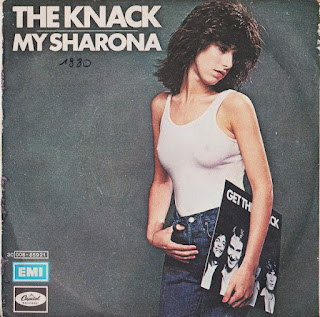
My Sharona and the Knack
The Knack, an American rock band formed in Los Angeles in 1978, achieved meteoric success with their debut single, "My Sharona," in 1979. This iconic song, with its distinctive, driving rhythm, propelled them to international fame.
Here's a breakdown of their key aspects:
"My Sharona" and "Get the Knack":
Their debut album, "Get the Knack," was a massive commercial success, largely driven by the popularity of "My Sharona."
Their style, a blend of power pop and new wave, resonated with audiences seeking a return to straightforward rock and roll.
Controversy and Backlash:
The band's image and some of their lyrics drew criticism, leading to a backlash that impacted their subsequent releases.
The band recived critisism regarding perceived misogyny.
Later Career:
Despite the initial surge in popularity, The Knack struggled to maintain the same level of success with their later albums.
They experienced periods of disbandment and reunions, continuing to perform and release music.
The bands lead singer Doug Fieger died in 2010, which resulted in the band disbanding.
Legacy:
"My Sharona" remains a timeless rock classic, frequently featured in films and media.
The band is remembered for its contribution to the late 1970s and early 1980s power pop scene.
The Knack's story is one of rapid ascent, intense scrutiny, and enduring musical impact.
Based on the information available, Sharona was:
Sharona Alperin:
She is the real-life inspiration behind The Knack's hit song "My Sharona."
She met Doug Fieger, The Knack's lead singer, when she was a teenager.
They later had a romantic relationship.
She also was in the picture on the single sleeve of the record.
She has gone on to have a successful career in real estate.

Wednesday, December 18, 2024
A Gilda's glance, a crimson wave of hair,
A smile that promised secrets yet untold,
Rita, a goddess on the silver air,
A vision sculpted out of purest gold.
From humble dance halls to the Hollywood gleam,
She rose, a Venus born of wartime dreams,
A fantasy, a captivating dream,
Reflected in the flickering film's soft beams.
But shadows lurked behind the painted face,
A fragile heart concealed by glamour's art,
A yearning for a love she couldn't trace,
A lonely figure playing a destined part.
Though time may fade, her legend will remain,
A timeless beauty, etched in memory's lane.


My woman's pleasure
A blush creeps up, a nervous thrill,
Anticipation, senses fill.
Not the usual path, a different way,
A journey to pleasure, where new sensations lay.
A delicate dance, trust is key,
Surrendering control, wild and free.
A tightness embraced, a stretching deep,
Breath catching softly, secrets to keep.
Pressure mounting, a unique sensation,
Pleasure entwined with slight trepidation.
A rhythm established, slow and then fast,
Each thrust building, a feeling to last.
Not the gentle sway of a familiar touch,
But a deeper connection, oh so much.
A primal response, a hidden desire,
Igniting a flame, setting my soul on fire.
Moans escape, a symphony of bliss,
In this taboo embrace, I can't resist.
Waves of ecstasy crash over me,
In this forbidden pleasure, I'm finally free.
A release so intense, a shuddering sigh,
In the aftermath, contentment does lie.
A bond created, intimate and raw,
Leaving me wanting, begging for more.
 the late Sharon Tate

Cinema part 2

Cinema
lets talk about cinema.
 Heather Graham is beautiful.
 But so was Hedy Lamarr.
To be honest, so many beautiful women cross the film and stage. Some last for 5 years others far longer, but the fact is they are all beautiful.
In praise, then, of beautiful women.
But so was Hedy Lamarr.
To be honest, so many beautiful women cross the film and stage. Some last for 5 years others far longer, but the fact is they are all beautiful.
In praise, then, of beautiful women.


Monday, March 18, 2024
Liberation Biology & Bioindustry Ethics (BOOK REVIEW FROM 2005) PUBLISHED IN BIOTECH LAW REPORTS
BioIndustry Ethics (2005); Liberation Biology (2005): BOOK REVIEW(S)
By Dr. Arthur Kyriazis, molecular biologist
Biotech Law Committee, AIPLA
For Biotech Law Reports
April 1, 2008
BioIndustry Ethics. David L. Finegold, C.M. Bensimon, A.S. Daar, M.L. Eaton, B. Godard, B.M. Knoppers, J.E. Mackie & P.A. Singer. (Available from and published by Elsevier Academic Press, 30 Corporate Drive, Suite 400, Burlington, MA 01803, USA, 2005). Liberation Biology: The Scientific and Moral Case for the Biotech Revolution. Ronald Bailey. (Available from and published by Prometheus Books, 59 John Glenn Drive, Amherst, NY 14228-2197). (Review copy available in hardcover, 332 pages, ISBN 1-59102-227-4, $28.00, Publication Date July 19, 2005).
Reviewed by Dr. Arthur Kyriazis, molecular biologist.
These two volumes are both indexed as “bioethics” volumes, yet two more different volumes could not be imagined. BioIndustry Ethics is a balanced, impartial study which deserves a place either on the professor’s reading list or on the shelf of in-house counsel at any biotech company, or on the shelf of outside counsel to a biotech company. The same cannot be said for Liberation Biology, which while admirable in scope and effort, fails at times on various accounts to be a fully academic study of the topics concerned, although suitable for a more general audience.
I. BioIndustry Ethics – Book Review
BioIndustry Ethics is a study of thirteen different biotech and pharmaceutical companies’ efforts to cope with a growing thicket of biotechnology ethics and regulatory environments by self-regulating. These companies in the main do so by delegating the job to Ethics Advisory Boards (“EABs”), which in turn draft model standards of ethical conduct for the companies to follow, et seq. Each chapter of BioIndustry Ethics is devoted to a solitary case study of a single company’s responses in the ethics realm. The specific companies studied in this volume are, seriatim, Merck, Genzyme, Millenium Pharmaceuticals, Maxim Pharmaceuticals, Diversa Inc., Pipeline Biotech A/S, TGN Biotech, the Partnership of Interleukin Genetics & Alticor, Sciona Ltd., Affymetrix, Inc., PharmaSNPs, Inc., Monsanto (during their bio-agriculture phase), and finally, Novo-Nordisk. The authors of the research, who have reported on their results and assembled these valuable case studies in BioIndustry Ethics are all university affiliated professors and scholars, who appear to be independent and impartial. The result is a rather dry, impartial and professorial study. At the inception of the study, the preface of BioIndustry Ethics states that “this book is the end product of a study that examined how bioscience companies are incorporating ethics into their decision-making….the book contains detailed case-study descriptions of how thirteen bioscience companies are approaching ethical concerns, primarily from the viewpoints of the executives and employees within the firms.”
In summary, BioIndustry Ethics is a useful and functional volume. For those who teach, this volume would serve as an ideal addition to the reading list of a course or seminar for the week or unit on ethics and regulatory matters. Specifically, this volume shows how startups all the way through large pharmaceutical companies can self-police ethics issues and thus avoid potential problems down the road.
Let us discuss the case of Merck. In Merck’s case, the fact that Merck has always had a clear mission statement and a public policy and image associated with serving the public first and profits second, has always served it well in terms of ethics and in terms of public image. The well-known Merck Manuals and other Merck publications distributed to the medical and nursing professionals and to the public, which have added to the cache of the Merck name. These are all matters raised in the Merck case study in BioIndustry Ethics. Many additional points are raised about Merck. Despite recent reverses, over the course of the last fifty years, Merck has been a model company with regards to ethics and public health issues. Merck early recognized that pharmaceutical companies bear a special responsibility in the greater fabric of society and the health professions, and that they have ethical duties and responsibilities. Consequently this may be viewed as one of the pivotal case studies in BioIndustry Ethics.
The other case studies in BioIndustry Ethics are just as vibrant and important as the Merck case study. They demonstrate that the use of in-house EABs, mission statements, policy statements and commitments to being ethical in the development and deployment of pharmaceutical and medical device products is the wisest course in avoiding conflict with government regulatory agencies in the bioethics arena. Self-policing and setting criteria in-house is clearly demonstrated from the case studies to be the best policy for both biotechnology companies and pharmaceutical companies to follow.
BioIndustry Ethics also belongs on the shelf of counsel and managerial employees of biotech companies, for the following reasons;
(1) So they understand how other small and large companies handle their ethics issues in-house;
(2) So they understand how EABs work and are set up;
(3) So they understand how mission statements work and are set up; and
(4) So they understand the background of ethics and self-policing of ethics in the industry generally.
Finally, this volume belongs on the shelve of private law firms representing the emerging or ongoing biotech, and/or ongoing pharmaceutical company, that the firm might accurately counsel their client regarding, and draft and set the client up with EABs, policy statements, mission statements and the like in the event the client company lacks them.
II. Liberation Biology Book Review
A more vibrant contrast between BioIndustry Ethics and Liberation Biology: The Scientific and Moral Case for the Biotech Revolution (hereinafter, “Liberation Biology”)could not be imagined. BioIndustry Ethics is a scholarly, impartial study which adheres to academic standards. Liberation Biology on the other hand appears to adopt a point of view at various turns, and at various places, the scholarship or warrant for various points is weaker than that which an academic would like to see.
The dustcover advises us that the author of Liberation Biology “Ronald Bailey is an award-winning science journalist, the science correspondent for Reason Magazine, a former television producer, and the author of Eco-Scam: The False Prophets of the Apocalypse.”
The title of the book itself is a pun on the phrase “liberation theology,” which was noted as a social gospel movement of the 1960s among Latin American catholic priests and nuns who wanted to spread a gospel of “true” Christianity to the poor downtrodden masses of Central and South America, hoping this might stir them to political action. Bailey’s argument from the sixties movement to his book title is somewhat different;
In the twentieth century, liberation theology was a spiritual movement aimed at helping humanity to overcome political and economic oppression. In the twenty-first century, liberation biology is the earthly quest to overcome to the physical and mental limitations imposed on us by nature, enabling us to flourish as never before.
The claims made for biology generally, and for biotechnology and pharmaceutical science in particular by Bailey, in this sweeping preface, are extraordinarily broad. They are so broad as to suggest that Bailey views biology as a panacea or cure-all for every one of humanity’s ills. This is a claim that no serious scientist would ever make. While it is true that the new biology holds out great promise for the possible cure of several significant diseases such as cancer or Alzheimer’s with which we have been struggling for some time now, no serious medical professional or biologist would claim the new biology will transform all of humanity as Bailey does.
But Bailey goes farther. Mr. Bailey labels his preface “Brave New World Reconsidered” and immediately plunges into a complicated argument—that the negative utopian novels of George Orwell and Aldous Huxley, 1984 (written in 1948) and Brave New World (written earlier) had such a negative effect on the 20th century that all biological experimentation was permanently discredited. Bailey calls this a “dystopic” effect of these two novels, and attempts to prove his thesis by quoting “liberal Boston University bioethicist George Annas” and Leon Kass “chairman of the President’s Council on Bioethics in 2001.” Then, a couple of paragraphs later, he relabels Kass and Annas “bioconservatives.” Reply to this flawed argument requires several levels of comment.
A. The History of Bioethics and Forced Sterilizations in the United States Pre World War II; Eugenics, Nazi Sympathizers and Official Anti-Semitism
As is now well-recognized, prior to World War II, certain members of the United States biology community were engaged for many years in a widespread eugenics campaign and movement. Moreover, eugenics had the widespread support of the entire United States legal, political and academic community; laws were enacted, forced sterilizations were carried out, and the German racial purity laws of the 1930s were based in large part upon similar laws on the books of the various states of the United States of the 1910s and 1920s. Eugenics was not confined to the biology community: virtually every state had by 1930 passed a eugenics-style forced sterilization law; the US Congress passed a racially motivated immigration-restriction bill in 1923-24 to prevent the immigration of southern Europeans and favoring the immigration of northern Europeans because of concerns over the dilution of the native American stock; and finally the US Supreme Court weighed in the case of Buck v. Bell, 274 U.S. 200 (1927). The situation was summarized by Prof. Jon Beckwith :
How Eugenics Ideology Took Hold In the Early Part of the Century
It is possible to distinguish several factors that led to a strong eugenics movement with significant social impact in the first twenty-five years of this century. First, there was the rediscovery of Mendel’s laws of inheritance around the turn of the century. Very quickly, scientists in this new field found that they could explain the inheritance of a host of simple traits by mendelian analysis. However, these same geneticists also very quickly began to attempt to extend this analysis to the inheritance of more complex traits, including human behavioral characteristics. In this early stage, between 1900 and 1915, a majority of the leading geneticists in this country supported this approach, which had serious eugenic implications. Among them were Pearl, East, Popenoe, Davenport, Conklin, Morgan, Jennings and Castle….It may be, that in some subtle way, the exciting discovery of the accurate predictive aspects of genetics influenced scientists to make an illogical jump to the much more complex behavioral traits. The new field of genetics thus either led to or reinforced ideas of biological determinism among them.
Prof. Beckwith does not stop there, however. He notes that Davenport, one of the leaders of the eugenics movement and founder of the Eugenics Records Office at Cold Spring Harbor Laboratories, made incredible claims for genetics and eugenics to explain human traits, unfounded by any real scientific basis;
…Davenport, one of the leaders of this [eugenics] movement, concluded that ‘alcoholism, seafaringness, degeneracy and feeblemindedness were each due to single mendelian factors.’ Davenport and others also claimed that the findings of genetics research demonstrated that mating between two races within a species would have breed inferior stock. For instance, it was suggested that mulattoes would have ‘the long legs of the Negro and the short arms of the white, which would put them at a disadvantage in picking things up off the ground.’
He also goes on to note the involvement of social and political forces at work in the eugenics movement:
Another factor at work in the growth of the eugenics movement was the increasing class conflict in this country [the United States] in the latter half of the nineteenth and early part of the twentieth century. There had been growing unrest of working people over industrial working conditions and wages. Labor agitation led to increasingly violent confrontations between workers and industrialists, culminating in the 1886 Haymarket bombing and riots. As part of the counterattack on workers, the industrialists and the newspapers that supported them began to push the idea that a lot of the trouble could be traced to immigrant workers. According to the New York Times ‘labor disturbances are brought about by foreigners’ and ‘demonstrations were always mobs composed of foreign scum, beer-smelling Germans, ignorant Bohemians, uncouth Poles and wild-eyed Russians.” Thus, ideas of eugenics and their supposed new scientific respectability were a godsend for the ruling class.
For instance, Albert Wiggam, who along with Madison Grant and Lothrop Stoddard, was a great popularizer of eugenics, stated:
‘Heredity has cost America a large share of its labor troubles, its political chaos, many of its frightful riots and bombing, the doings and undoings of its undesirable citizens. Investigation proves that an enormous proportion of its undesirable citizens are [sic] descended from an undesirable blood overseas. America’s immigration problem is mainly a problem of blood.’
Davenport, speaking before a conference of social workers, stated that ‘social reform is futile and the only way to secure innate capacity is by breeding it.’ [Professor] McDougall, Chairman of the Department of Psychology at Harvard, called for the ‘replacement of democracy by a caste system based upon biological capacity with legal restrictions upon breeding by the lower castes and upon intermarriage between the castes.’ Eugenics took strong enough hold so that even Margaret Sanger, a feminist, socialist and birth control advocate, suggested in 1918 and in 1919 that ‘all our problems are the result of overbreeding among the working class….[m]ore children from the fit, less from the unfit—that is the chief issue of birth control.’
As a consequence of the overwhelming scientific support for the eugenics movement, and its consonance with socio-political movements of the time, Prof. Beckwith notes, “funding was quickly forthcoming from leading industrialists to support the eugenics movement.” Prof. Beckwith goes on to note that “[i]n 1907, the Harrimans, Kelloggs and Carnegies funded the opening of the Eugenics Record Office at Cold Spring Harbor, Long Island.” As the author notes, “the Eugenics Record Office was located at the site now occupied by The Cold Spring Laboratory of Quantitative Biology” and “[t]here still exists at this laboratory an extensive collection of eugenics literature from this [the 1907-1945] period.” This, of course, is the same Cold Spring Laboratory made famous by James Watson and others of note in more recent times.
The archives of the Cold Spring Harbor have given rise to one of the most valuable research sources on American eugenics, because their summaries have been carefully and systematically put on line for scholars and laypersons to examine. These can be found at the “Images Archive on the American Eugenics Movement” at www.eugenicsarchive.org/eugenics. The website contains nearly all of the original material on Davenport, who headed up the Cold Spring project for many years, and many others who contributed to the eugenics movements, and contains many academic as well as photographic references, along with an exhaustive look at laws and policies that flowed from the eugenics movement.
The overall impact of the eugenics movement in the United States and in other countries was substantial. In the United States along, Prof. Beckwith notes, “[b]etween 1911 and 1930, 33 states passed laws requiring sterilization for a variety of behavioral traits deemed to be genetically determined. These included, depending on the state, such characteristics as criminality, alcoholism, tendency to commit rape, sodomy or bestiality, and feeblemindedness. Many of these laws are still on the books [as of 1976] and have resulted, since that time, in at least 60,000 [forced] sterilizations.” Prof. Beckwith goes on to note that the greatest number of sterilizations were performed on the grounds of feeblemindedness, based on administration of IQ tests administered by the U.S. Public Health Service, then run by a Dr. Goddard; the same IQ tests found feeblemindedness in 83% of Hungarians, 87% of Russians, 83% of Jews and 79% of Italians. Thirty-four states passed miscegenation laws banning marriage between African-Americans and whites, and in many cases between Asian-Americans and whites, and these laws were not declared unconstitutional until the case of Loving v. Virginia in 1967.
But long before the Warren Court had its say, the eugenics movement also had its day at the Supreme Court as well, in a now infamous opinion of the Hon. Justice Oliver Wendell Holmes, in the case of Buck v. Bell, 272, U.S. 200 (1927). In the case of Buck v. Bell, Virginia resident Carrie Buck in 1924 was raped. Carrie Buck’s alleged Binet-Simon IQ test purportedly revealed her ‘mental’ age to be nine (9) years old, and her mother, Emma, was also alleged to have had a ‘mental’ age of less than eight (8) years old. As a consequence, Emma Buck, the mother, was confined to the State Colony for Epileptics and the Feeble-Minded at Lynchburg, Virginia. Upon the birth of Carrie Buck’s daughter, Vivian Buck, on March 28, 1924, Virginia authorities brought a test case to authorize the forced sterilization of Carrie Buck.
After a trial November 18, 1924, the trial court found that the Buck family was part of the “shiftless, ignorant and worthless class of anti-social class whites” in the south, and that Vivian, the child, “was not quite normal.” Bell appealed to the U.S. Supreme Court through her attorneys. The U.S. Supreme Court, per Oliver Wendell Holmes, ruled against Buck and in favor of the Commonwealth of Virginia in a 7-2 decision on May 2, 1927, following which Carrie Buck was forcibly sterilized due to her legal and medical diagnosis as a “moron” in October 1927. Justice Holmes wrote for the majority as follows;
Experience has shown that heredity plays an important part in the transmission of insanity and imbecility. We have seen more than once that the public welfare may call upon the best citizens for their lives. It would be strange if it could not call upon those who already sap the strength of the State for these lesser sacrifices, often not felt to be such by those concerned, in order to prevent our being swamped with incompetence. It is better for all the world, if instead of waiting to execute degenerate offspring for crime, or to let them starve for their imbecility, society can prevent those who are manifestly unfit from continuing their kind. The principle that sustains compulsory vaccination is broad enough to cover cutting the Fallopian tubes. Three generations of imbeciles is enough.
According to one source, after Justice Holmes’ ruling in Buck v. Bell in 1927, “numerous states passed similar laws [to Virginia’s forces sterilization laws] and Nazi Germany gave the fullest sweep to the movement [of eugenics]. This case provides a strong argument for careful scrutiny, especially at the local level, of ideas ground upon popular notions of science.” According to another source, “[b]y1927, before Carrie Buck lay prostrate beneath Dr. Buck’s surgical blade, almost 8,500 American citizens had been forcibly sterilized. This ‘official’ figure, taken from informal surveys by proponents of the procedure and representing only what surgeons chose to report, would reach well over 65,000 in the decades to come. Ill-educated and poor, these people were operated upon and mostly forgotten.” According to the same source:
After Carrie [Buck’s] sterilization [in 1927], there was a renewed push to pass new laws, and institutions in states that had already approved the procedure began sterilizing inmates at a dramatically higher rate. In all, at least thirty states, as well as the territory of Puerto Rico, passed laws to quell the tide of hereditary defectives through forced sterilization. After 1927, this American technique of social engineering became the model for laws in Canada, Denmark, Finland, France and Sweden. In 1933, in one of the first acts of the newly elected government of Reichschancellor Adolf Hitler, the National Socialist Party enacted a comprehensive sterilization law modeled consciously on American legislation.
This was not the nadir of pre-world war II American bioethics eugenics activity. As the anti-Jewish activities of the Nazi regime slowly came to light during the 1930s and thereafter, pressure came upon Congress to relax the very strict immigration quota which had been placed upon Jewish immigration under the Immigration Act of 1924. However, repeatedly, when this issue came up, in 1934 and again in 1938, eugenics leaders such as Harry Laughlin testified and wrote to Congress specifically opposing relaxation of the quota for Jewish immigration:
There is a movement now to make special legislative provision for the Jews persecuted in Germany,” [Dr.] Laughlin wrote in 1934. As Jewish refugees fled the systematic brutality of Adolf Hitler and the new regime in Germany, a host of New York civic groups and private citizens demanded that the Chamber of Commerce, responsible for processing most immigrants after they had come to the country through Ellis Island, offer asylum to these foreigners driven from their homes. When the chamber’s chairman, John B. Trevor, set up this special commission to study whether its members should grant any emergency exceptions to the Immigration Act of 1924, he asked Laughlin to prepare a scientific report on these questions. ‘Dr. Laughlin is beyond doubt the foremost authority in the United States today on the subject,’ Trevor said, “and his previous researches along similar lines for the Committee on Immigration and Naturalization of the House of Representatives peculiarly fitting him for the task.’ Laughlin presented his report in the first week in May 1934 and his recommendations were unambiguous: political oppression and forced emigration were not valid reasons to ease the nation’s immigration curbs.
Complicating the situation was an executive order from President Hoover restricting emigration under the German quota unless the emigrant could prove beyond a reasonable doubt they could not become dependent on government aid. The conclusion:
Based on Laughlin’s report, the Committee on Immigration made three terse recommendations: “No exceptional admission for Jews who are refugees from persecution in Germany. No admission for any immigrant unless he has a definite country to which he may be deported, if occasion demands. No immigrant to be admitted whose ancestors were not all members of the white or Caucasian race.”
The United States Congress did not alter its stance from 1934 to 1938, and Dr. Laughlin continued to oppose changing the quotas to admit Jews persecuted by the Nazi regime. The situation did not substantially improve during the war, and the failure to admit the Jewish refugees into England or the United States even as the Holocaust was underway remains one of the most shameful chapters in our history. What is not so generally recognized is that the refusal to admit the refugees had its origins, at least in part, based on “scientific” theories of eugenics made popular and politically palatable prior to World War II.
B. The Post World War II Era – the Nuremberg War Crimes Trial, the United Nations, the Founding of the Israeli State, Human Rights and Crimes Against Humanity – the Modern Era of Condemning Eugenics Begins
The modern era of bioethics really begins with the defeat of Germany, the discovery of the horrors of the Holocaust, and the Nuremberg War Trials. But in order to make its case of war crimes at Nuremberg, Justice Jackson and the prosecution team had to specifically spell out that the Nazi’s use of race-purification and discrimination against lesser races on the basis of genetics was a crime against humanity as exemplified in Justice Jackson’s opening statement to the tribunal:
[The Nazis] took from the German people all those dignities and freedoms that we hold natural and inalienable rights in every human being. The people were compensated by inflaming and gratifying hatreds towards those who were marked as “scapegoats.” Against their opponents, including Jews, Catholics and free labor, the Nazis directed such a campaign of arrogance, brutality and annihilation as the world has not witnessed since the pre-Christian ages. They excited the German ambition to be a “master race,” which of course implies serfdom for others. They led their people on a mad gamble for domination.
In the context of the Nuremberg trials, Nazis were put on trial for experimenting on human beings, for systematic programs of genocide and eugenics programs (including the Nazi “lebensborn” program to “breed pure Nordics” and negative eugenics programs to eliminate “non-Germans”—thus giving rise to the world’s first official legal glimpse at what genocide was and how it worked on a statewide scale.
The upshot for the eugenics movement in America was all too clear. As one authority puts it:
As revelations of the Holocaust stunned the world [during the Nuremberg War Crimes Tribunal Trials], it became impossible for eugenic reformers to carry on their message of racial purity in the United States. Their foremost leaders, Charles Davenport and Harry Laughlin, had passed away [during World War II], and many of their organizations soon folded or simply removed the term “eugenics” from their names. After Ezra Gosney, the founder and president of California’s Human Betterment Foundation, died in 1942, the sterilization program in the most eugenically active state began a precipitous decline…Other eugenics organizations became devoted to a new cause: world population control.
With Nuremberg came the United Nations Declaration of Human Rights, the advent of genocide scholarship, the recognition of rights in all minorities in all nations, and a slow but gradual evolution of recognition on the parts of all societies which forcibly discriminated against their minorities (such as apartheid societies like South Africa or the Jim Crow South of the United States) that change must come through lawful means. That this was a worldwide rather than a countrywide movement is a testament to the far-reaching vision of Justice Jackson and the Nuremberg prosecutors and to the founders of the United Nations.
Key also was the founding of the Israeli state in 1948, a homeland for the Jewish people. Because the United States became a key backer of its founding, due to Pres. Truman, who also committed to the desegregation of the armed forces and of the federal government during his administration, Israel became a model for human rights early in its history and a place where all citizens of Jewish ancestry could find haven. The notion that all persecuted minorities were entitled to homelands, to dignity and to respect, took on greater emphasis in the post-world war II milieu with the UN and the founding of Israel. This had a profound effect on how biologists and the public generally viewed the claims formerly advanced for eugenics, which was now regarded as something vaguely German or Nazi-like in scope and in thinking. Indeed, the U.S. biology community spent much of its post-world war II time doing all that it could to rid itself of the memory of eugenics and to devote itself to the serious new sciences of DNA and molecular biology and biochemistry which were now rapidly developing and which promised real advances in actual genetics and true genomics.
C. The Current Era of BioEthics and the Claims of Liberation Biology
Having examined the pre-World War II history of bioethics and eugenics in the United States, we are now in a better position to debunk Bailey’s claims that the negative utopian works of Orwell and Huxley somehow discredited biological experimentation. First, as to Huxley, it is now fairly clear that Huxley’s work, far from being serious, was in fact intended as a parody of the excesses of the eugenicists. The “brave new world” of Huxley, taken almost word for word from almost any of the eugenics enthusiasts such as the psychology professor we encountered at Harvard during the early part of this century, is in fact intended as a gross joke to demonstrate how sickening and disgusting a world without democracy, devoted to eugenics and classification by function and biology, such a world would be. As such, the book has become a classic in dystopianism, or portrayal of negative utopia, especially in light of the disclosures of the Nazi horrors revealed during the Nuremberg war trials era.
What is difficult to see is how this wonderful book has impeded, in any way shape or form, modern biological progress. The alpha-helix was elucidated by Linus Pauling; Watson, Crick & Franklin discovered the structure of DNA; crystallography began to uncover the three dimensional structure of proteins such as carboxypeptidase-A; and the modern eras of molecular biology and biochemistry were begun during the 1940s and 1950s. The new genetics were a far cry from what the eugenicists were doing; serious geneticists were karyotyping chromosomes, searching for physical defects, and looking for the keys to life in the structures of the gene itself.
Likewise, it is difficult to see what if any relevance Orwell’s work 1984 has to the subject of biology. Written in 1948, the title is a numerogram of its date of writing, and the book is intended as a dystopic parody of both socialism and totatalitarianism, both of which Orwell was opposed to. Orwell was a champion, as everyone knows, of liberty and freedom. But as to how this book impeded modern biology, other than the assertion of the author, we have little evidence. If anything, generations of students who have studied both Orwell’s and Huxley’s works have grown up legitimately opposed to communism and fascism, and to the misuse of science by any central authority with too much power; and if that is true, that is probably a good thing. Perhaps the defeat of the Soviet Union and the liberation of Eastern Europe have not been in vain.
Regarding Bailey’s alleged sources on this assertion, Distinguished Professor’s Annas and Kass, if there is one thing we can be sure of, it’s very likely that these two do not agree on very many points, as Annas is fairly liberal and Kass fairly conservative. While both of them would like to regulate modern biotechnology, Annas would like to do so for the society’s right to regulate from above any scientific activity, which amount to liberal bioethics reasons, while Kass’s concerns derive from his conservative, deeply and well-held concerns for the dignity and morality of the individual, which propel Kass to believe than nearly any interference in the natural conception activities are somehow wrong. However, there is nothing intrinsically wrong with the viewpoints held by either scholar, and secondly, it is impossible to see how these viewpoints support Bailey’s argument that Orwell’s and Huxley’s works have played a role in blocking the past, present or future of biotechnology or of biology.
There are other flaws in Bailey’s work, too numerous to comment in so limited a space as this. Suffice it to say that Bailey makes numerous claims in his book, but fails to make the necessary arguments to hold them together; as either his warrants for his claims are deficient, or his evidence is lacking, or his arguments are of a form that do not prove the argument, such as being of an ad hominem nature, attacking a straw man, arguing over irrelevant issues, asserting the existence of a homogenous “bioconservative” monody that does not quite exist, and so forth. One could cite numerous such instances but suffice it to say that the book falls short of academic or even logical standards of reasoning, proof, citation and argument. Moreover, the work is argumentative at nearly every turn and fails to take a balanced or reasoned approach to any of its topics, which mars whatever other value the work might have had as a reference.
A work on bioethics can certainly take a point of view, but in doing so must be measured and persuasive if it is to capture the audience to its position. Each chapter of Liberation Biology beats a drum for its various positions, but the chapters fall short of being persuasive arguments or even marshalling evidence for their views. One must assume in writing a book that one is attempting to either persuade one of the opposing view, or further convince the true believer. In either event, every statement made in a book must be calculated towards one end; persuading the reader towards the thesis of the writer. First and foremost, the writing must be logical and persuasive, and secondly, the evidence in support of each and every point must be marshaled at every turn. Consistently, Liberation Biology makes assertions instead of arguments; strings together statements rather than making progressive argumentation; fails to be logical or to follow logical syntax; and at every turn where evidence is demanded, mere assertions or conclusions are offered up. In short, the book’s methods of organization, argument and evidence are disappointingly short of the usual academic and logical standards.
Far from adhering to academic standards, Liberation Biology engages in a good deal of invective, characterization, faulty reasoning, logically inconsistent or logically fallacious analysis, and in general, contains many passages which are difficult to follow. Chapters are poorly written, poorly edited, poorly organized, and some chapters could be better viewed as a rant against the author’s favorite targets than as serious academic writing. Liberation Biology consequently cannot be viewed as a well-written, well-reasoned, well-evidenced and well-argued book on bioethics. The contrast with the companion volume being reviewed here could not be more striking.
III. COMPARING AND CONTRASTING THE TWO WORKS TOGETHER
To understand these two works together, one must propose a paradigm that envelops the entire body of regulation and ethics in the biotech/pharma sphere. This paradigm is easy enough. If there is an ethics problem, there will be one of three solutions; either private industry will police it themselves; the government will regulate it through the states or federal government; or the government will directly legislate on the matter through the states or federal government. There can also be permutations of the two, such as joint industry-state or industry-federal regulation, as we have with FDA approval.
Although Bailey is correct to some extent that bioethics experts such as Distinguished Professor Annas usually call for direct federal legislation to solve specific bioethics problems, this is not true of all bioethics experts in the United States. For an example of a leading bioethics expert who turns to non-governmental organizations (“NGO’s”) for the solution to bioethics problems, we can consider Dr. Andrea Bonnicksen, Ph.D., of the University of Northern Illinois.
Dr. Bonnicksen has been in the bioethics field for more than twenty-five years. Her advocated solutions to most bioethics are as follows:
(1) Industry should always set up Ethics Advisory Boards (“EABs”) in house;
(2) Industry should have ethics advisors and ethics consultants at all stages of startup and operations;
(3) Industry should self-police;
(4) It’s not a conflict for academics to consult to industry on ethics issues frequently; in fact, it’s a valuable service they render;
(5) If the government has to get involved, as much as possible, have the industry self-regulation, or devise a regulatory system which give the industry financial incentives to obey the regulatory scheme.
Bonnicksen takes industry ethics seriously, and while she accepts that the federal government can do a good job of regulation and of legislation, she correctly puts the onus for most of that regulation on the companies themselves.
Of these two volumes, therefore, the first, BioIndustry Ethics, is by far the more valuable, since it presents us with specific case studies. Chapter One presents us with the case study methodology, which is organized and thorough, and Chapter Two gives us the first, and perhaps most interesting case study—Merck—which since its founding by George W. Merck and a speech he made in 1950, has stood by the Merck credo and Merck Mission Statement for more than fifty years: “We try never to forget that medicine is for the people. It is not for the profits. The profits follow, and if we have remembered that, they have never failed to appear. The better we have remembered that, the larger they have been.” The case study analyzes this statement and the Merck Mission Statement, set forth at length therein, and concludes that there are two main points; first, that Merck is a long-term player, committed to research and development of long-term drugs; and second, that Merck is devoted to patients’ health and well-being as a whole.
The self-regulatory approach—endorsed by Dr. Bonnicksen and other centrist bio-ethicists working in the field—and evidenced to be working by such case study works as BioIndustry Ethics—presenting a model of mission statements, as with Merck, and EABs and internal ethics advising groups, as with many other companies—seems to make a great deal more sense than the panoply of increased governmental regulation and micromanagement advocated by Bailey in Liberation Biology or by governmentally- oriented bioethics professors who almost always suggest the government as the cure to all problems. NGOs or non-governmental organizations have the capacity to fully regulate bioethics, or at least police a good proportion of the known issues. While the captivity of government regulatory agencies is a well-known phenomenon and beyond the scope of this review, clearly government regulation is not the solution to any problem in private industry so long as the regulation consists of an agency that eventually will be co-opted by industry lobbyists and interests. It is surely better to rely on the current environment of letting private industry police itself and let the bioethics professors work directly with industry in these EABs promulgating guidelines as consultants. To this extent, BioIndustry Ethics proposes far the more ethical solution to the bioethical complexities our industry faces in the years ahead.
THE END
Monday, January 29, 2024
ABOUT THE HISTORY OF THE JPEG
THIS IS MAINLY TAKEN FROM ANOTHER POST.
Lenna Soderberg was the centerfold model of the November 1972 issue of Playboy Magazine. She had a beautiful figure, an amazing ass, and eyes that gazed deep into your loins. She also, inadvertently, played a leading role in advancing the field of image processing.
The USC Signal and Image Processing Institute
In the summer of 1973, Alexander Sawchuck, a professor at the USC Signal and Image Processing Institute, was laying the groundwork for research that would end up being the foundation of the JPEG and MPEG image standards. He and his assistants had a paper they intended to present at an upcoming research conference, and needed a good image to use to demonstrate how good their compression algorithm was.
While many existing “stock” images existed that were common in the nascent image processing industry of the time, Alexander and his colleagues wanted to use something new — something different. The image had to have a human face and it had to be glossy so that it could demonstrate large dynamic range. As they contemplated what image to use, someone happened to walk into the lab holding the most recent issue of Playboy. Inspired, Alexander and his colleagues looked through it, and thought the centerfold image of Lenna would be a perfect choice.
The photo scanning equipment in the lab at the time had a maximum resolution of 512x512, and could only scan 100 pixels per inch, and so the engineers ended up picking the following crop of the image to be used in the paper:
The paper they presented ended up being absolutely canonical in the industry, and as a result countless other engineers and researchers wanted a copy of the Lenna image, so that they could compare their work on image processing with that of USC.
“Visitors asked us for copies, and we gave it to them so they could compare their image processing and compression algorithms with ours on the same test image.” — Alexander Sawchuck
By 1991, Lenna was literally everywhere in the image processing world. If you looked at any journal, book, or conference paper related to image processing, you would likely see the above picture of Lenna multiple times (in various stages of compression).
One example of Lenna (sometimes spelled “Lena”) in a journal
Things reached a fever pitch in July 1991 when the journal Optical Engineering put the photo on its cover. This caused the use of Lenna to come to Playboy’s attention, and understandably they were initially very unhappy — all these engineers had violated their copyright!
Luckily, the editor of Optical Engineering called Playboy and was able to get them to say they were okay with the use of Lenna, so long as it was only for research and educational purposes. As a result, the image has continued to be used, even to this day. If you look at any modern image processing research, there is a good chance it includes at least one picture of Lenna.
Lenna with various modifications
Lenna and a monkey?
Lenna and some graphs
What journal has embraced the Lenna craze the most? The IEEE Transactions on Image Processing journal.
What about the actual girl?
Lenna Soderberg has actually become somewhat of a celebrity in the image processing world as a result of all of this. While she moved back to Sweden, got married, and raised some children after her Playboy shoot, she found out about her presence in all of these image journals during an interview in 1988.
She was quite pleasantly amused, and since that time has actually been invited to a number of international image processing conferences. She was a guest at the 50th annual conference for the Society for Imaging and Technology in 1997, and was also the guest of honor at the 2015 IEEE (probably the most respected electrical engineering society in the world) International Conference of Image Processing, where she delivered a speech and helped chair the best paper award ceremony.
“The use of her photo is clearly one of the most important events in the history of electronic imaging.” — Jeff Siedeman, Chair of the Society for Imaging and Technology
In recent years, there has been a lot of discussion regarding whether it is sexist to have the primary image example used in the field of image processing to be what was originally a nude woman. To draw attention to this issue, a 2012 paper on image processing used an image of Fabio (see page 6).
Lenna today
Whatever your take, there is no doubt that Lena was a foundation for modern image processing. Her image turned out to be perfect for visualizing the effects of image compression — its detail, flat regions, shading, texture, and gloss all played a role. Plus, the original image was pretty good too :)
Photography
Tech
Davis Treybig
https://medium.com/five-guys-facts/lenna-e802b18d9ddc
Tuesday, September 12, 2023
I exist, therfore I am
Hello.
I Exist.

This is Erica Durance, who used to be famous on Smallville.

This is someone else, a well know model and producer. LA stuff, you know.
That's all for today, September 12, 2023
Wednesday, February 2, 2022

Tuesday, May 29, 2018
THE NEW NEW
RHETORIC; E-MAILING, SOCIAL NETWORKING AND BLOGGING VIEWED AS FORMS OF
ARGUMENTATION AND RHETORIC
Buried on a single page of September
2009’s WIRED magazine is a marvelous piece by CLIVE THOMPSON called “THE NEW
LITERACY.” Much of what I’m about to
discuss is drawn directly from Mr. Thompson’s article, and I expressly
attribute to him as souce material at p. 048 of the September 2009 issue of
WIRED magazine.
 |
| Ashley Judd is our favorite Harvard Educated Feminist! |
According to Thomson, far from
inhibiting today’s generation of kids from writing, the computer age of emails,
facebook and other social networking tools, etc., and blogging, along with chat
sessions, have actually INCREASED substantially the amount and type of writing
that this generation does. Id.
These striking conclusions are based
on a study by Prof. Andrea Lansford, professor of writing and rhetoric at
Stanford University, known as the “Stanford Study of Writing,” which collected
14,672 writing samples of students from 2001-2006—including class assignments,
formal essay, journal entries, emails, blog posts, chat sessions and posts to
social networking sites. Id.
 |
| Amy Schumer and Chuck Schumer would be a great Democratic Ticket for 2020, no? |
Conclusions? “I think we’re in the midst of a literary
revolution the likes of which we haven’t seen since Greek civilization.” Id. Id.
 |
| Wittgenstein's Tractatus - the very culmination of Greek Civilization. Also, unreadable. |
According to Prof. Lansford, before
the internet, most Americans never wrote anything that wasn’t an assigned
school assignment or job assignment. Id. Id.
Moreover, the KIND of writing online
had a form to it—it was RHETORICAL, PERSUASIVE writing—focused on the audience,
and getting a point across. Id.
Prof. Lansford specifically
concludes that the “modern world of online writing, particularly in chat and in
discussion threads, is conversational and public, which makes it closer to the
Greek tradition of argument than the asynchronous letter and essay writing of
fifty years ago.” Id.
 |
| John Wooden's Pyramid of Success - You can't go wrong with anything depicted here. It Works! |
The article goes on. “For students today…writing is about
persuading and organzing and debating…the Stanford students were almost always
less enthusiastic about their in class writing because it had no audience but
the professor: it didn’t serve any purpose other than to get them a
grade.” Id. Id.
The bottom line of the article and
of the Stanford-Lunsford study is that students today are using new media to
become debaters, rhetoricians and persuasive writers and speakers. Their writing is concise and focused on
specific target audiences, and the anticipation of responses and replies forces
them into debater-like preparation for extensions, rebuttals and replies. What we have, then, with the new media of the
internet, is a new new rhetoric, and a new type of debating and persuasive
speech. Id.
 |
| The Author at right attending one of his innumerable Harvard Reunions. The brilliant young woman at left is the daughter of one of his classmates. You can tell a Harvard Man, but you can't tell him much. |
This phenomenon deserves
considerably further study from the speech, rhetoric and debating community.
Wednesday, January 29, 2014
RetroTweets – Divisional Play, Wild Cards, MVPs and Cy Young Winners 1900-1919. 1900, 1901 redux, 1902
RetroTweets –
Divisional Play, Wild Cards, MVPs and Cy Young
Winners 1900-1919.
1900, 1901 redux, 1902
 |
| 1904 Harvard Baseball Team with African-American Baseball-Team Member Matthews in Front Row. See, that wasn't so hard? It only took Organized Baseball 43 more years to integrate. |
In a prior column
posted back on August 1, 2013, we introduced the idea of “Retrotweets” and
examined how the National League and American League could have been split into
East and West Divisions in 1901, and how they could have had wild cards and
playoffs in 1901.
We could examine each
of the seasons in detail but for the sake of brevity, let us summarize our
findings by era. This column will be
devoted to the so-called “Deadball Era” 1901-1919. The next columns will be devoted to the “Babe
Ruth/Lou Gehrig/Lively Ball Era” 1920-1939.
After that will be “World War II and the 1950s” 1940-1959. Following that will arrive “The Expansion Era
- !960-1979” Part I and then “The Expansion Era Part II – The Juice is Loose –
1980-1999”. Of course, divisions were
introduced in 1969, but we will look at whether there could have been three
divisions of four teams as early as 1969, and whether there could have been
wild cards as early as 1969.
This excerpt covers 1900, 1901 and 1902.
 |
| 1913 World Champion Philadelphia Athletics Managed by Connie Mack Fatima Cigarettes Team Photo w/o Hall of Famers Eddie Collins, Chief Bender, Frank "Home Run" Baker, Eddie "Gettysburg" Plank, and Manager Connie Mack. The A's won AL Pennants in 1902, 1905, 1910, 1911, 1913 & 1914, and World Series in 1910, 1911 and 1913. Players they signed but did not keep included Hall of Famers Napoleon "Nap" Lajoie, & Stan Coveleski, and the infamous Shoeless Joe Jackson. |
In addition, we will
furnish lists of the NL and AL MVPs and Cy Youngs for each year. One caveat here is that for the early years
of the 20th century, due to the fact that pitchers throw so many
innings, often close to 400 IP per year, their win shares and WARs tend to
swamp out the win shares and WARs of positions players every single year, so
for the deadball era and possible for the next quintile of twenty years, we
will have an overall MVP and then a position player MVP, because the overall
MVP will usually be a starting pitcher. Looking
further on down the line, in some more recent years, relief pitchers have
received the Cy Young award. This is
hardly ever merited based on WAR—no relief pitcher is ever worth as much as a
starting pitcher in terms of WAR or win shares due to the fact that modernly,
relief pitchers only throw about a hundred innings or less. So we’re going to have to give them a
separate designation as well for the last twenty years or so. (of course, prior to 1985, relievers threw
two or three innings at a time, and two hundred innings a years, but that’s
another story). So let’s retrotweet and
examine the history of baseball’s division winners wildcards MVPs and Cy Youngs
as they were meant to have happened…
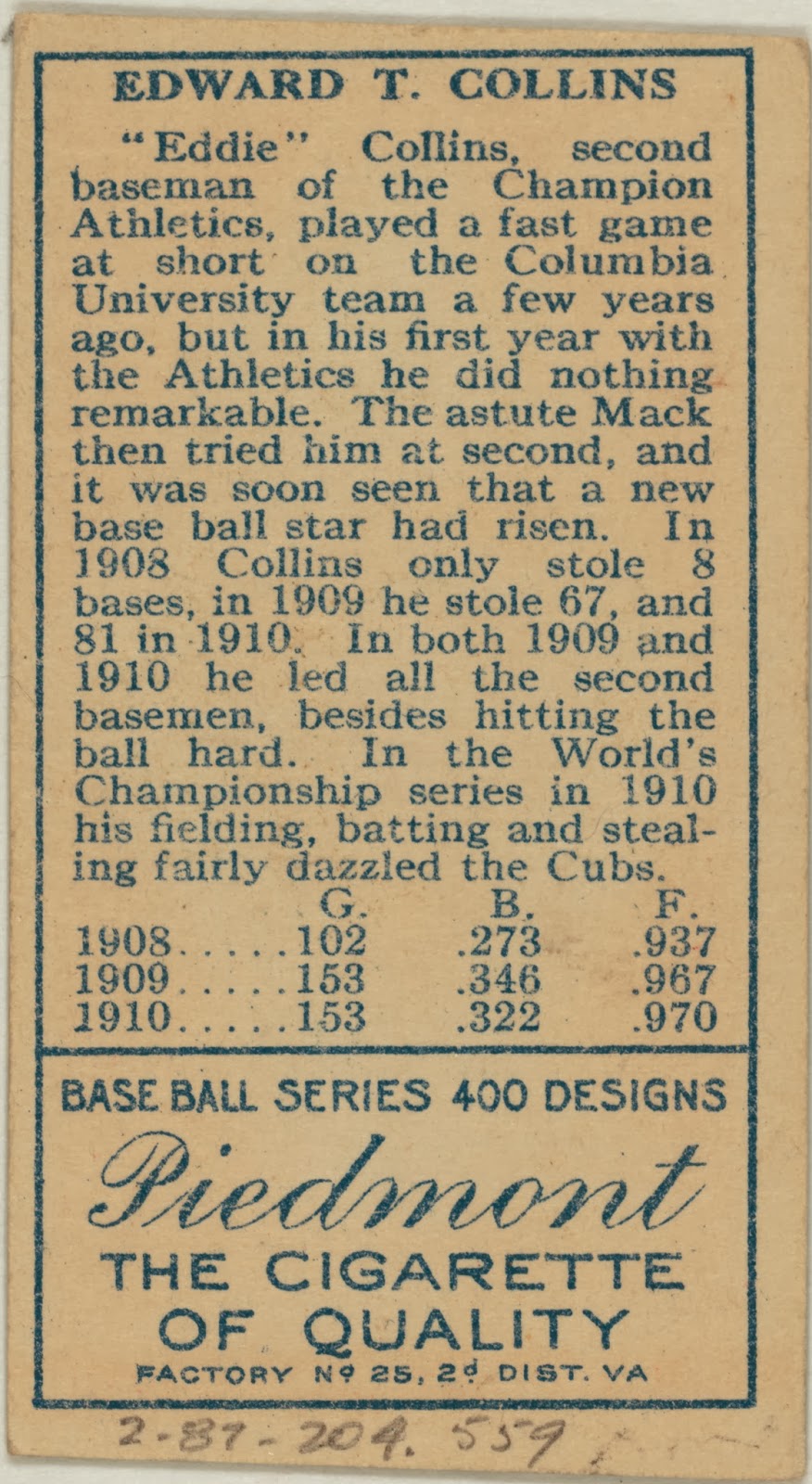 |
| Eddie Collins Baseball Card, Rear w/ Text & Stats, 1910 |
 |
| Eddie Collins 2b HOF Philadelphia Athletics Baseball Card Front below, Back, Above. The White Elephant was the symbol of the Philadelphia Athletics for nearly all of their existence. |
Going back to the 1900
National League:
1900
National League
NL
East Record GB
Brooklyn 82-54 -----
Phila 75-63 8
Boston 66-72 18
NYGiants 60-78 23
NL West
Pitts 75-63 -----
StL 65-75 9
Chi 65-75 9
Cin 62-77 13.5
For 1900 the
Division Winners are Brooklyn & Pittsburgh; the Wild Cards are the Phillies
and the Braves. The Playoffs are the
Braves at the Pirates and the Phillies at the Superbas (now the Dodgers). Brooklyn was really mostly the former
Baltimore Orioles, which with the Braves had won the vast majority of NL
pennants during the 1890s, while the Phillies had often come in 3d or 4th. The Pirates were a newcomer, having absorbed
several key players from the dissolved Louisville franchise, notably Honus
Wagner and Fred Clarke, both of whom would have HOF careers, along with some
key pitchers. Thus, four very good
teams. Hard to pick these playoffs. We’ll guess that Brooklyn and Pittsburgh
might make it to the NLCS, but after that, a coinflip. And, since the AL is still a year away,
that’s the championship.
1900 NL Overall MVP – Denton True
“Cyclone Cy” Young aka “Cy Young”, P, St. Louis with a 7.3 WAR. Best position players were Honus Wagner of
the Pirates and Elmer Flick of the Phillies, tied at 6.8 WAR.
1900 NL Position Player MVP – Co-Winners,
Honus Wagner, Pirates, Elmer Flick, Phillies, tied, 6.8 WAR.
1900 NL Cy Young – Cy
Young. 7.5 pitching WAR. Yes, that Cy Young. And he was already 33 by 1900 and still
throwing smoke. Young only went 19-19
but the St. Louis Perfectos aka Cardinals were 65-75, and they stunk. And this was Cy Young’s 12th best
season in terms of WAR. Young, Wagner
& Flick will all end up in the HOF.
1901 AL and NL – we did in an
earlier blog. The Phils won the NL East
and the Pirates won the NL West, with Brooklyn and St. Louis as wild
cards. Boston won the AL East while the
Chisox won the AL West, with the Phila As and Detroit Tigers as Wild
Cards.
1901 NL Overall MVP – Christopher “Christy” aka “Big Six” aka
“Matty” Mathewson of the New York Giants.
9.0 WAR easily leads the NL.
1901 NL Position Player MVP- Highest
position player WAR is Bobby Wallace of the St. Louis Perfectos aka Cardinals
with a 7.7 WAR. Wallace was a superb
fielder and RH hitter who could run and hit some as well. Wallace’s’ career total defensive WAR of 28.7
is 8th all-time behind 1)Ozzie Smith, 2) Mark Belanger, 3)Brooks
Robinson, 4)Cal Ripken, 5)Joe Tinker, 6)Luis Aparicio, 7)Rabbit Maranville &
8)Pudge Rodriguez. Nice company. Both Mathewson & Wallace are in the
HOF.
1901 NL Cy Young – Christy
Mathewson, 9.1 WAR as a pitcher. Christy
Mathewson attended Bucknell University in Lewisburg, PA, and is buried at
Bucknell. Many believe him to have been
the greatest pitcher of all time, and he has certainly inspired generations of
baseball players at Bucknell.
1901 AL Overall MVP– Cy Young, now
of the Boston Red Sox, with a 12.6 WAR.
The best position player is Nap Lajoie of the Philadelphia Athletics
with an 8.4 WAR. Young and Lajoie are
both HOFers.
1901 AL Cy Young - Cy Young.
12.6 pitching WAR. This time,
pitching for a 1st place division winner, he goes 33-10 with a 1.62
ERA leading the league in strikeouts and ERA+.
So that’s two Cy Youngs for Cy Young.
If you neutralize his stats to a 750 run season, it looks like
this: 43 wins, 5 losses, 1.41 ERA, 434
IP, 354 H, 7 HR, 185 K. You’d have to
say Cy Young was the gold standard by which you’d measure any pitcher. He didn’t start pitching until he was 23, but
he had more than 500 career wins anyway.
1902 AL & NL
1902 NL
NL
East Record GB
Brooklyn 75-63 -----
Boston 73-64 1.5
Phila 56-81 18.5
NYG 48-88 26
NL
West
Pitts 103-36 -----
Cinn 70-70 33.5
Chi 68-69 34
StL 56-78 44.5
Division Winners are
Brooklyn, NL East, and Pirates, NL West.
Wild Cards are Boston Braves and Cincinnati Reds. The NL Playoffs will be Reds at Pirates and
Braves at Trolley Dodgers/Robins. The
Braves/Dodgers is a flip, while the Pirates would probably crush the Reds. After that, the Pirates would probably crush
the winner of the Braves-Dodgers matchup.
Brooklyn has its second division win in three years and was a wild card
in 1901 Pitts has won its third
consecutive NL West division crown. The
Phils after a wild card and a division crown have fallen out of the playoff
hunt due to losses to the AL, the big one being HOF Ed Delahanty jumping to
Wash of the AL. Boston is a wild card
for the 2d time in three years.
 |
| 1950s Relief Pitcher Gus Constantine Keriazakos. Not a Deadball Player, but I like him because, after all, his name is pretty much Kyriazis with a few vowels and consonants re-arranged. And, he played for the Athletics, though not until they were in KC. |
 |
| The Back of Gus Keriazakos' Baseball Card. For some reason, the KC Athletics in the 1950s had a lot of Greek-American ball-players, including Gus Keriazakos, Lou "The Nervous Greek" Skizas, and John Tsitouris, who is famous in Phillies lore for beating the Phillies in Game One of the Ten Game Losing Streak that cost the Phils the 1964 pennant. Beware of Greeks throwing 1-0 shutouts in which Chico Ruiz steals home.... |
This is probably where
we discuss the world famous “Honus Wagner” baseball card. Honus Wagner did not smoke, and therefore did
not want his picture on a tobacco company endorsed baseball card. He asked his card be pulled from production
after a small initial run. Thus, very
few were made, and the cards that were made instantly became exceedingly rare.
1902
AL
AL
East Record GB
Phila As 83-53 -----
Bosox 77-60 6.5
Wash 61-75 22
Balt 50-88 34
AL
West
St. Louis 78-58 -----
Chisox 74-60 3
Cle 69-67 9
Detroit 52-83 21.5
The Philadelphia
Athletics, already managed by Connie Mack, have captured the AL East Division
crown after getting a wild card the previous year, while the St. Louis Browns
have rocketed from last to first and captured the NL West Division. The wild cards are the Bosox and the Chisox,
who were division winners in 1901. The
AL playoffs will be Chisox at As, and Bosox at Browns. Note that under a divisional setup with wild
cards, the St. Louis Browns get into the playoffs in 1902; in the 8 team league
setup, the Browns had to wait until 1944 to win a their one and only pennant in
St. Louis. All four teams are pretty
closely matched, assuming 7 game series and 2-3-2 home away home splits, it’s
gotta be close. First, let’s give the
edge to the Bosox because they have Cy Young who can pitch three times in a
four game series. Next, the As have
Eddie Plank and Rube Waddell, which is a pretty good 1-2 punch in a short
series, so let’s pick them over the Chisox, who have not yet got Ed Walsh. That leads to an ALCS of As v. Bosox,
featuring Plank and Waddell v. Cy Young Bill Dineen and Tully Sparks. This is really a flip—the As have great
hitting but Boston has great defense with Jimmy Collins, Freddy Parent and Hobe
Ferris in the infield. At the end of the
day, slight edge to Boston because of Cy Young, probably in a 7 game
series.
That brings us to the
World series, which will be Pirates v. Bosox.
This ends up being the 1903 World Series, but let’s not get
distracted. The Pirates have good but
not great pitching, with Jack Chesbro, Deacon Phillippe and Jesse Tannehill (a
southpaw). But oh what offense, with
Honus Wagner, Fred Clarke, Tommy Leach, Ginger Beaumont, Claude Ritchey and
Kitty Bransfield all with huge OPS+ numbers.
Boston has to win at least 2-3 games because of Cy Young, but the rest
of the games will be the Pirates bashing Boston pitching around. The pick has to be Pirates in seven.
1902
NL Overall MVP -
Jack Taylor, P, 3b, OF Chicago Cubs, 10.2 WAR.
Taylor actually earns 9.3 WAR as a pitcher, and then also plays
additional games at 3b, the OF and 1b, where he excels as a hitter and
defensively, and earns additional WAR.
1902
NL Position Player MVP - The position player to
come closest to Taylor is Honus Wagner at 7.2 WAR. Honus Wagner has now won the NL Position
Player MVP two of three years.
1902
NL Cy Young Award – Jack Taylor, P, Chicago Cubs, 9.3
pitching WAR. He is closely trailed by
Noodles Hahn of the Cincinnati Reds with 8.9 pitching WAR. Jack Taylor posts his best season by far in
the big leagues, going 23-11 with a league leading 1.29 ERA, a league leading 8
shutouts, a league leading ERA+ of 206, and a league leading WHIP of .953. He allows 2 HR in 333 2/3 IP, 273 H, 45W and
88K. His line normalized to a 750 run
context has him going 33-6 with a 1.63 ERA, 353 IP, 338H, 2HR, 56W and a 1.116
WHIP. According to his SABR bio, Taylor
pitched 187 consecutive complete games from June of 1901 to August of
1906. It’s doubtful we’ll see the likes
of that again. Cal Ripken only appeared
in 2,500 whatever consecutive games; Taylor pitched nearly 200 consecutive COMPLETE games over a six year
period. Taylor’s is by far the greater
feat.
1902
AL Overall MVP -
Rube Waddell, Philadelphia Athletics.
10.3 overall WAR. Cy Young close
behind at 10.1 overall WAR. Both are in
the HOF.
1902
ALPosition Player MVP - The position player to
come closest to Waddell & Young is Ed Delahanty of the Washinton Senators
at 6.7 WAR. Long a Philadelphia
Phillies, and destined for the HOF, Delahanty batted .400 twice in the 1890s,
hit 4 HRs in a game, and was considered the game’s premier hitter and LF. His defection to the AL hurt the Phillies
badly—they went from winning 83G in 1901 to losing 81G in 1902—though Delahanty
was only part of the story. He would
lead the AL in doubles, BA, OBA, SA and OPS+, posting a .376/.453/.590/1.043
line with 10HR, 14 3B & 43 2B, 93 RBI and 103R scored, for a team that went
61-75.
1902
AL Cy Young Award – Cy Young, 10.0 pitching WAR, nosing
out Rube Waddell, 9.7 pitching WAR. Both
HOFers. Cy Young has won three straight
Cy Youngs.
to be continued.....
Subscribe to:
Posts (Atom)